Wednesday, 4 September 2013

ICRC 2013 - Day 6 Tuesday 3rd September

For our morning devotions today Rev Richard Holst took us through 1 Thessalonians 1:1-12, emphasising the self-giving nature of Paul's ministry and applying this to our gospel ministries. Ministry is self-giving, which means it is also self-denying.

Rev Peter Azuana
The first presentation of the day was by Rev Peter G Azuana, from the Universal Reformed Christian Church (NKST), in Nigeria. Their application for membership was incomplete so the conference encouraged the Churches sponsoring them to help complete the application in time for the next conference in 2017. Rev Azuana gave details of the NKST and their work which aims to be holistic and extaended to all nationalities. They have 557 pastors, 353 congregations, a university, a seminary, a Bible College, 53 secondary schools, 500 primary schools, nine hospitals with clinics, schools for nursing, midwifery, medicine and technology. In addition they also have orphanages. I must confess that I felt very small, inactive and humbled by such a report! How thrilling to hear about such a wide range of activities all related to gospel work! Their women's ministry is distinctive, with Bible studies and evangelising prominent in their activities.The NKST's university is distinctly Christian but is seen by the government as a rival and they do not support the Church. Rev Azuana asked for prayer in regard to the university especially.

Next up was the report of the Missions Committee of the ICRC. This was presented by Rev Raymond Sikkema. A booklet with details of mission work engaged in by the member Churches was distributed to the conference and Mr Mark Bube took us, in his own engaging style, through much of the detail. The Missions Committee had met with representatives of the World Reformed Fellowship and the committee hoped that
Mr Mark Bube and Rev Raymond Sikkema
the conference would mandate them to send some of their number to the WRF Missions meeting.

After dealing with a report from the Advisory Committee on Finance and another Advisory Committee report on incomplete applications Rev Rowland Ward presented a second report by the Advisory Committee on the Review Committee's report. A number of questions were received and comments made and the discussion was then left to be continued at a later session.

After another very good lunch provided by the refectory the conference heard reports from the worskshops which had discussed the paper by Dr Jin Ho Jun. Dr Jun then gave his responses to questions raised from the floor. After this the discussion of the Review Committee's report continued resulting in a number of the recommendations being accepted. Any recommendations to do with the ICRC Constitution, rather than the Regulations, must first be sent to the members Churches for their Assemblies or Synods to consider so that their responses can then be taken up at the next conference.

The afternoon session was concluded with a presentation by Rev Jos Colijn, Kampen University giving information about a new project commissioned by the Synod of the Reformed Churches in Netherlands. In this they proposed to offer a research Master of Theology with the aim of developing students in their studies of Reformed Theology to a level of academic excellence. They were hoping to identify future Church leaders and invite them to work together as a learning community. The task will be to train trainers and to form an international community of Reformed theologians who will take what they learn at Kampen and apply it in their home contexts.

In the course of the day we, the Free Church representatives, held meetings with delegates from the Reformed Presbyterian Church in North East India and later with the Presbyterian Free Church Central India. The representatives of the RPCNEI were Rev L Kiemlo Pulamte and Rev Ros Infimate. We discussed matters which were common to us as Churches but also received from them information about their denomination and the work they are engaged in. The RPCNEI began in 1979 with 5 families and now
have 104 congregations, with 14,000 members and 45 pastors. Due to the shortage of pastors they need to care for 4-5 congregations each. They have congregations in 5 Indian states and also in Myanmar and have 38 missionaries working in various locations in neighbouring states to Manipur where their headquarters is situated. They have a home for children and a programme of vocational training for young people so that they may be able afterwards to earn a livelihood. They have support from the Reformed Churches in Netherlands (Liberated) and network with various groups in the Reformed Christian Fellowship.It was good to meet with these brothers in the Lord and we hope to be able to remain in close contact to see if there can be any scope for a closer relationship between the two Churches.

The relationship of the Free Church to the Presbyterian Free Church Central India is a special one. This Church was established through Free Church missionaries and today, although the Free Church has no missionaries in Central India seeing the PFCCE has been self-sufficient for many years, we regard them with a special affection. Rev Shyam Babu and Rev Samit Kumar Mishra conveyed to us the love of their Church and outlined a number of issues which they wished to bring back to the Ecumenical Relations Committee, including their Diploma in Theology programme and Lakhnadon school which faces financial challenges at
Rev Shyam Babu and Rev Samit Kumar Mishra
present. They also spoke about the challenges currently faced from Islam and from the authorities, and also how their aim as a Church is to raise spiritual leaders from local communities who will preach the gospel to their own people. Shyam and Samit are heading to Scotland after the conference to give talks at various locations in the Free Church, but unfortunately their already full programme means that we will not have the pleasure and benefit of hearing them in Lewis. We asked them to take our love and prayers back to their congregations in Central India.

After dinner much of the evening was taken up with the report of the Advisory Committee on the application from the Christian Reformed Churches in Australia. The report was given by Rev Jack Sawyer, of the OPC.
Rev Jack Sawyer
The Committee's report raised sensitive issues and a lot of time was spent discussing various options relating to procedure as well as some points raised in the Committee's report. At 9.15pm the conference accepted a motion to refer the report back to the Advisory Committee for them to report back next day. This was wise considering the importance of decisions about whether or not to receive a Church into membership of the ICRC. These decisions should not be taken with tired minds and it was best to reflect and pray over the matter for the next day's business. It was appropriate that we sang "Praise, my soul, the King of heaven" at he conclusion of the evening. All decisions are under his sovereign appointment and he is always deserving of our praise.

Monday, 2 September 2013

ICRC 2013 - Day 5 Monday 2nd September

Today at conference we began with worship at which Rev Richard Holst gave an exposition of 1 Thessalonians chapter 2. After this a presentation was given by Rev Geoff van Schie of the Christian Reformed Churches of Australia which is making application for membership of the ICRC at this conference. Geoff's ministry is varied and depends much on support from others financially but he is thankful to report many instances of God's blessing on his ministry.
Rev Geoff van Schie
This was followed by a discussion of the report of the Review Committee which was recommending changes to certain aspects of the ICRC Regulations. No final decision was arrived at as the document requires further consideration the amendments proposed by the Advisory Committee which looked at the Report. This was followed by the second “workshops” session where issues raised by the second paper given by Rev James Visscher on Friday, “The Nature of Preaching”, were discussed. Our group concentrated for most of this session on the matter of “appeal” in preaching. We dealt with how preaching ought always to have an "appeal" element both to those who are confessing Christians and to the unsaved.

During the lunch break we had a very pleasant and profitable informal meeting with Rev Heon Soo Kim and Rev Byoung Kil Chung of the (Korea) who had both visited Lewis on their way to the conference. Although the Free Church has a fraternal relationship with them as members already of the ICRC we explored the possibility of taking this further so as to develop closer relations where there could be mutual assistance and edification in gospel ministry. This is one of the good and important aspects of the conference that time is available for delegations to meet so that the relations we share in the gospel are applied as much as possible to the extending of God's kingdom.

Then it was time after lunch to hold a plenary session at which a brief report was given by each of the four workshops after which Rev Visscher gave his response to the points raised.

The conference then considered another presentation, this time from the Reformed Churches in Korea given by Rev DongSup Song. This denomination is young, with four ministers and around 200 members, founded in 2005, and is now seeking admission to the ICRC. This application will be reported on later in the conference by the Advisory Committee set up to examine it.

Rev Patrick Jok and Rev Daniel Kithongo
The Committee examining the application from the African Evangelical Presbyterian Church, given by Rev Daniel Kithongo last Thursday, reported. The Committee was recommending that the application be received. The conference unanimously accepted the AEPC into membership and Rev Kithongo was then welcomed as now a sitting delegate of the Conference. The Chairman led the conference in prayer.

Before the coffee break another report was received, this time from the Committee examining the application from the Sudanese Reformed Churches. Again the Committee was recommending that the conference receive the application favourably and admit the SRC into membership. This was agreed to unanimously by the conference and Rev Patrick Jok was then welcomed as a sitting delegate of the conference. The Chairman again led the conference in prayer.

It is such a heartening experience to be part of a conference admitting these relatively new churches into membership of the ICRC. When we are so used to dealing with declining numbers in our churches and are free from poverty and persecution how humbling and challenging it is to see growth in churches set amongst poverty and persecution, with an obvious commitment to maintain Reformed theology, preaching and church order. It's a cause of much thankfulness for the growth but of much prayer that our decline would be turned around by the power of the Holy Spirit.
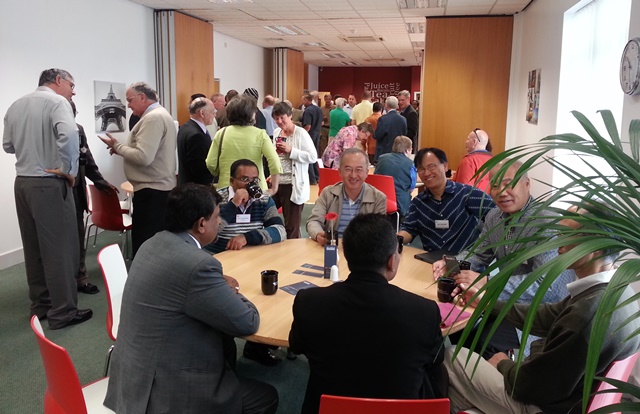
Coffee (and tea) time
Dr Ho Jin Jun
The evening session began with worship, led by Rev Pila Nkuka, Reformed Church of Indonesia NTT, who spoke from Colossians chapter 2. This was followed by the delivery of the third and final paper of the conference "Preaching in Illiterate Cultures" given by Dr Ho Jin Jun, Cambodia Presbyterian Theological Institute. It's hard for us to imagine what it must be like to preach the gospel in a context of illiteracy where many of the hearers cannot read a text or write. Africa has a 40% literacy rate and Asia 20%. Dr Ho's paper dealt with the illiteracy situation in Asia mostly and gave details of the practices used in preaching in that situation.

There was just time for another presentation from a church already in membership of the ICRC but which had not yet managed to give such a presentation to conference. This was the Reformed Churches of Brazil, located in north east Brazil and the presentation was given by Rev Luiz Fernando. The RCB developed from missionary work carried out by Canadian and Dutch missionaries in the 1970's, one of whom was the Corresponding Secretary to the Conference, Rev Cornelius Van Spronson.
Rev Luiz Fernando


Saturday, 31 August 2013

ICRC 2013 - Day 3 Saturday 31st August

Beautiful sunny day and very warm today in this lovely spot. Our bus left at 9.45am for our trip to the "Big Pit" Coal mine (so called because of the width of its shaft, 5.5 metres at its widest point, the biggest in the area when it was completed), near Caerphilly. The other bus took a second group to Cardiff and Cardiff Castle.
From the hill overlooking the Big Pit mine
The Big Pit mine was really interesting. Actually going down the pit shaft and being shown the various parts of the pit made the whole experience very authentic. We were given a safety helmet and a belt with a power pack for the light which attaches to the helmet. All possessions with a dry battery, phones, cameras, watches etc had to be left in safe keeping before going down the shaft in the cage for safety reasons. A slight spark from a battery connection could trigger an explosion. Now, in descending the 50 metre vertical shaft it helps if you don't mind close fellowship because 20 people in a smallish cage does make for a pressing experience!
Even the model horses looked real!
Once down we were then taken along the mine by an ex-miner who showed and explained various aspects of how the mine worked, the tools and equipment used, the horse stables and equipment, the signalling methods etc. In early times whole families worked for mine owners for little return and the children would operate doors at certain points along the length of the mine in total darkness. We were asked to switch off our helmet lights and when the guide switched his off he asked us to hold our hands in front of our face. We could not see anything! I was reminded of those verse in Exodus chapter 10, which describe the plague of darkness - "Then the LORD said to Moses, "Stretch out your hand toward heaven, that there may be darkness over the land of Egypt, a darkness to be felt." So Moses stretched out his hand toward heaven, and there was pitch darkness in all the land of Egypt three days. They did not see one another, nor did anyone rise from his place for three days, but all the people of Israel had light where they lived."


We were then told about a disaster which occurred in 1913 and being down in a mine while being told made it all the more solemn as took in the details. The Senghenydd Colliery Disaster, also known as the Senghenydd Explosion, occurred in Senghenydd, near Caerphilly, killing 439 miners. It is the worst mining accident in the United Kingdom, and one of the most serious globally in terms of loss of life. The demand for Welsh steam coal before World War I was enormous. Among other uses it fuelled the Royal Navy's huge fleet of steam battleships, dreadnoughts and cruisers, and was also used by foreign Navies allied to Britain and the British Empire. The explosion was probably started by methane gas being ignited, possibly by electric sparking from equipment such as electric bell signalling gear.

The initial explosion disturbed coal dust present on the floor, raising a cloud that then also ignited. The shock wave ahead of the explosion raised yet more coal dust, so that the explosion was effectively self-fuelling. Those miners not killed immediately by the fire and explosion would have died quickly from afterdamp, the noxious gases formed by combustion. These include lethal quantities of carbon monoxide, which kills very quickly, the victims being suffocated by lack of oxygen. This disaster led to new and safer methods of signalling, detection methods for methane gas and eventually to the Davy Lamp, still used to detect methane gas.

There are a number of exhibition buildings on the site containing all kinds of exhibits and the coffee shop was a welcome sight after emerging from the dark, damp and cold mine shaft!


Given the conditions in which miners had to work, the sharing of danger and disaster, a short visit down the Big Pit mine made it easy to see why mining communities had such strong bonds between families and individuals, some of which remain today. It also helps to explain why miners' unions looked after their members with such a fierce loyalty and went to such lengths to protect them and their jobs.

The Picket Caravan
No account of our Big Pit visit would be complete without a photo of the picket caravan, used no doubt during the miners' strike in the era of the Thatcher government. It could tell many a tale of scuffles, shouts of "scabs", police charges, Scargill speeches, endless cups of tea and coffee. It's appearance now as an exhibit is a somewhat sad statement of how the mining industry has all but disappeared leaving lives, relationships and communities changed forever. In its heyday Big Pit employed 1300 workers. Now there are none apart from those guiding visitors into its shafts.

Following this we proceeded to Caerphilly castle, the largest castle in Wales. It was begun in 1268 by Gilbert de Clare, known as "Gilbert the Red", possibly due to his red hair. The castle proved a very handy refuge for Edward II in 1326 as he fled from his wife Isabella and her companion, Roger Mortimer! It is surrounded by a series of moats and small islands and has a drawbridge. The south-east tower of the castle leans at a greater angle than the famous Tower of Pisa! It's difficult to do justice to this in a photo but it is really scary to look at!

The figure bottom left seen holding it up is not a hunky Welsh hero but a wooden substitute! The sheer bulk of these castle walls is amazing. Imagine how it must have been for those armies trying to storm these walls or attempt to penetrate them with medieval war engines! I saw no sign of the fabled Green Lady who is said to haunt the site! There were, however, a few pale men around, as by this time a number of us were feeling the need of replenishment at Cooper's Carvery where we were booked to have our evening meal.


We were joined there by the other bus which had returned from their trip to Cardiff and Cardiff Castle. The roast beef was good and roast turkey and ham were also available. A recent visitor to the Garrabost manse commented, however, that the Yorkshire Puddings "did not match up" and added "I was comparing them with Donna's!" Well, that's a good note on which to finish and a wee reminder to me of why I should be thankful!


ICRC 2013 - Day 2 Friday 30th August

Rather damp and drizzly for most of today in beautiful Treforest campus. Our conference day began with worship, as is proper, at which the Chairman Rev Richard Holst gave the first of four expositions of Paul's first letter to the Thessalonians. After a plenary session covering a number of routine items the conference listened to Rev Patrick Jok of the Sudanese Reformed Churches. His denomination is applying for membership of the ICRC at this conference. In an impressive talk and presentation he outlined the plans the SRC has for church planting, evangelism and social ministries in the years ahead. The war in that region in recent years has left its devastating legacy on the lives of many people and infrastructure, with the result that


The SRC started as a small house fellowship in Khartoum, Sudan in February1992. It was time of great Christian persecution in Sudan. By God’s grace SRC has now grown into 16 churches all over South Sudan and Sudan with 8 ordained pastors and 15 evangelists. In the SRC strategic plan (2011-2015), it is hoped to plant 36 more churches: 25 in South Sudan and 11 in Sudan!

The conference then divided into four discussion groups or "workshops", one of which I was assigned to chair, in which the paper given at yesterday's evening session by Rev Dr Robert Letham was discussed. Our discussion for an hour was stimulating and rewarding. Dr Letham had raised issues in his paper that really got us thinking. For example, in what sense is the preaching of the Word of God "infallible"? Or, is the preaching itself "the Word of God" at the same time as it is preaching "from the Word of God"? Also, in what is usually called "revival" when many more people are converted than at other times and when the power of the Holy Spirit is experienced above what is known at other times, is the preacher himself changed, does the preaching changed? In addition, does a concentration on the need for "revival", including praying for this, tend to demote the preaching of the Word in circumstances outwith "revival" to an "ordinary" level. And is it right to pray for "extraordinary" preaching (in the sense of what is associated with "revival) with preaching outwith such occasions regarded as "ordinary"? Finally, what do we mean by "revival" when we think of the preaching of the Word of God? So, the theologians back home should have plenty here to get their teeth into till I get back!

As you can imagine there were many contributions to the discussion, not all of the same mind! But we ended the discussion with the conviction that preaching and the Holy Spirit are inseparably joined, what Letham calls "distinct but inseparable ( this also applies to the Trinity, the two natures of Christ, the composition of human beings as physical and spiritual). We also agreed that the preaching of the Word of God carries out the sovereign will of God in the sense that his word never returns to him "void" or "empty" and always accomplishes what he has chosen to bring about both in the conversion of some and the hardening by others of themselves under the Word.

A break in the afternoon from 3-5.30pm helped me to catch up on some emails and to make a start on this blog post! After our evening meal we had the second lecture of the conference delivered by Rev James Visscher, a minister in the Canadian Reformed Churches, whose topic was "The Nature of Preaching". Again, on Monday we are due to discuss this paper in our workshops.


After the evening session Rev Patrick Jok met with Iain D Campbell, Rev David Miller and myself, as representatives of the Ecumenical Relations Committee, to discuss how the Free Church might be able to set up closer relations with the Sudanese Reformed Churches and what the relationship would mean to both denominations. This was a very interesting and productive discussion and again Patrick impressed us with his account of how the denomination had started with small beginnings, with himself actually, and had grown by God's blessing to the 16 congregations they presently have. It would be wonderful if we could have Patrick speak to ujs back in Scotland about the Sudanese Reformed Churches and their commitment to church planting, evangelism, theological education in schools and their overall approach to what it is to serve Christ in the gospel.

Tomorrow (Saturday) most of the delegates are going on arranged trips to local sights, one group to a coal mine and Caerphilly Castle, the other to Cardiff and Cardiff Castle. Apparently Wales has more castles in proportion to its total area than any other country in the world! Mind you, it maybe has something to do with that lot over the border!

I will try and find time when we get back from the trip to give a brief account, provided I don't get left down the coal mine!

Thursday, 29 August 2013

ICRC 29th August

With help from Flybe I arrived last evening at the Eighth meeting of the International Conference of Reformed Churches (ICRC), at the Glamorgan Conference Centre, University of South Wales,
Treforest, Pontypridd, near Cardiff. This is a modern, beautiful campus, set into the hills. Along with me from the Free Church are Iain D Campbell, who travelled with me all the way from Lewis, Bob Akroyd and David Miller. The hosting denomination is the Evangelical Presbyterian Church in England and Wales (EPCEW). We attended the opening service of the conference at one of their congregations Immanuel Presbyterian Church in Cardiff last evening. The service was conducted by the minister there Rev Dr Peter Naylor who is also the clerk to the conference. The sermon was by Rev Iain Hamilton, Cambridge Presbyterian Church, another EPCEW congregation. Great emphasis on the triumph of Christ and how we as his people share in a triumphant procession with him. Others are in the procession too, but not sharing this victory; rather they are in chains as defeated enemies, Satan and his forces. Stirring stuff!

This is the congregation taking their seats just before the service began. One or two faces may be familiar!

Today (Thursday) we spent most of the morning confirming who were present representing the member churches, around eighty delegates in all, and also observers from other churches. In addition, importantly, a welcome was given to the wives of delegates, although sadly for one delegate (actually a few others too!) Donna was missing!

After lunch we spend time giving preliminary considerations to a report from the Review Committee set up at the last meeting in 2009 in New Zealand. The Committee was charged with looking at the structure of the conference and how it might be improved in line with the growth in the number of members churches since the ICRC was set up in 1985 in Edinburgh. This is a long document running to some 50 pages, so the conference will need to give more than one session to it. Hopefully it will be adopted near enough as it is as, having been on the committee, I know that a great deal of time and care was spent on it, and it should help to make the ICRC more efficient as a conference of churches holding to the Reformed tradition.

In the afternoon we saw a presentation given by Refo500, an  international platform for knowledge, expertise, ideas, products and events, specializing in the 500 year legacy of the Reformation. Worldwide, more than 120 partners have joined Refo500 and the number of partners is still growing. Partners collaborate in order to offer a program and to tell the story of the Reformation. Refo500 partners include Protestant and Catholic organizations, churches, universities, museums, cities, publishers, and others.


Rev Dr Robert Letham
After our break for our evening meal we had the first lecture of the conference from Rev Dr Robert Letham, a lecturer in Systematic Theology at the Wales Evangelical School of Theology, formerly Evangelical Theological College of Wales. Previously he was Senior Minister of Emmanuel Orthodox Presbyterian Church Wilmington Delaware for 17 years.

 Dr Letham's subject was "The Necessity of Preaching", giving us some important reminders of what preaching is and why we preach. His lecture was an excellent, scholarly, insightful, stimulating, and thought-provoking presentation. Tomorrow we will have four "worskshops" (discussion groups) on his lecture so that we can get into more of the detail and application of the lecture.

Rev Daniel Kithongo
The final item on the evening's agenda was a presentation from Rev Daniel Kithongo from the Africa Evangelical Church, in Kenya, one of the churches applying for membership. In his presentation he referred to the persecution of some of their congregations by militant Muslims, who in some case will drive a car which contains a bomb to a church service, park it close to the church and then leave the scene. It appears that they are just arriving for worship like others but the car explodes just as the worshippers are arriving for the service. Try and imagine what it would be like if our attendance at church had to face this! Please pray for them as they seek to be true to the Lord against such intimidation and violence.

This was a very good day. The Lord was honoured, fellowship was good, much was learned and quite a few new relationships established.


Thursday, 15 August 2013

A Clean Mouth

By "a clean mouth" I don't mean the kind the dentist wants to see, although this is recommended! No, I'm referring to the words we use in conversation. The principle also extends to all the written forms of communication we use. Bad language, "swearing" or "blaspheming" has always been with us, but never has it been communicated as much, because of our technologically advanced age, and as unashamedly as in our society. In everyday conversation, books, films, songs, and videos, the regular use of blasphemous, coarse, vulgar language, is commonplace, leaving many children with the idea that such words are normal and acceptable. I suspect that "go and wash your mouth out" is much less used now than a generation ago and would be regarded only as an order to brush one's teeth! This is not surprising in a society that has moved so much from the precepts of the Bible as a foundation for moral conduct and for the "norms" of conversation.

However, my concern lately is with the number of Christians who seem to have little problem with "liking" pages or comments on Facebook that have words or images which contain coarse, vulgar language, like the "f" word. The bad language used by unbelievers is one thing; we should not be surprised at that. But condoning or commending it, even not being offended by it, on the part of those who confess Christ as their Lord is another thing altogether. The Lordship of Christ extends to the words we use and how we use them. We have to speak to all, always, as if we were speaking directly to him. "He who loves purity of heart, and whose speech is gracious, will have the king as his friend (Proverbs 22:11)." 

In the third commandment we are told "you shall not take the name of the Lord your God in vain", which we mostly associate with careless or irreverent use of God's name. We tend, rightly, to call this "blasphemy", a term we will look at below. Taking God's name "in vain" includes every unjustified use of God's name in a frivolous, insincere, empty or disrespectful way - treating God lightly in other words. We break this commandment when we use the name of God yet do not take him or the ideals of his kingdom seriously. How many times do we hear people who have no personal faith in God say "O my God"? Or, think of the stand-up comedian whose routine includes jokes about God, uses the coarsest language, then waves to the audience at the end and says " Bye, God bless" - and, yes, Christians sometimes laugh along with him, or her, in the privacy of their homes! Or, again, think of the vicar in England, Rev Alice Goodman, who has a sticker on her car with the letters wtfwjd? which stands for "what the f*** would Jesus do?" She states that the middle word is not blasphemous but is a vulgarity, as if that itself were alright! Of course this is blasphemy, bringing the name Jesus into a disreputable connection with an acknowledged vulgarity, and so is a transgression of the third commandment. Even if her motive was good the method is decidedly bad!

So blasphemy is disrespectful speech against God, in particular when one or more of the names of God, including Jesus and the Holy Spirit, is included. However, the matter of our quality of speech is much wider than the way we use God's name or names.  In the New Testament the same Greek words as are translated "blaspheme" and "blasphemy" are also used in a wider application. For example the Greek verb blasphemeo is used in Romans 3:8. The ESV translates this "slanderously charge us", the NIV has "slanderously claim that we say" and the AV "slanderously reported". In each case the Greek verb blasphemeo is given the meaning "to slander".

In other words blasphemeo is to speak disrespectfully, profanely, slanderously, or in similar vein, against God, or human beings, or even the possessions of Christians (2 Peter 2:2) and angels (2 Peter 2:10), whether or not the names of God are directly used. Compare Titus 3:2 where blasphemeo is translated "speak evil of" (ESV and AV) and "slander" (NIV). It's interesting to compare the Oxford Dictionary of English definition of "blasphemy", which is "the action or offence of speaking sacrilegiously about God or sacred things; profane talk", and gives the origin of the word as "from Greek blasphemia -slander, blasphemy." So in translation we should probably confine "blaspheme" and "blasphemy" to the context of speech directly against God, while the other meanings of the word tell us that quality of speech does not end at how we speak about, and to, God.

Along with this we should note the many descriptions of speech mentioned in the Bible. This includes "perverted" speech (Proverbs 2:12), as well as speech that is "smooth" (Psalm 55:21), "prudent" (1 Samuel 16:18), "crooked" (Proverbs 4:24), "seductive" (Proverbs 7:21), "truthful" (2 Corinthians 6:7), "sound" (Titus 2:8) and "gracious" (Proverbs 22:11 and Colossians 4:6). As well as being harmful words can be, and ought to be, beneficial to others.  Our speech and our written words are vehicles which convey what is in our mind, thoughts, emotions and attitude - channels for good or bad. Through our words we give vent to anger, flattery, pride, falsehood, jealousy, praise, joy, excitement, compassion, and many other personal traits, all of which reveal aspects of our character. This is one reason why the Bible has so much to say about our words and how we use them. The Letter of James devotes the whole of chapter three to this! Our speech can have have devastating effects for good or bad. A guide in Norway was once asked by one of a climbing party if avalanches were common in that area. The guide pointed to a heavy overhang of snow in the distance and said, "See the big overhang of snow on that mountainside. One word can bring all that down!" Sadly it's like that in life, including life in the Church. Our words all too often bring an avalanche of trouble rather than a volume of good.

Paul's statement in Colossians 4:6 bears closer inspection - " Let your speech always be with grace, seasoned with salt, so that you may know how you ought to answer each person." The words "seasoned with salt" are explanatory of "with grace." As a right amount of salt adds savour to food, without which it would be bland, so our speech should carry a good savour to those we speak with. "Salty" speech does not mean speech that is abrasive, stingy, or alienating, even when we need to be challenging or admonitory, but rather speech that is positively beneficial and helpful to those we speak with. The avoidance of coarseness and vulgarity is only one side of our quality of speech (or writing) as Christians, although it is a very important and necessary side in today's world. The other side is the wholesomeness of our language. It must communicate the savour of godliness. Quality of speech is more than the absence of harm in our words: it's also persuasive of good.

The verse ends, "so that you may know how you ought to answer each person." This has an apologetic or evangelistic ring to it. Our way of speaking is a vital element in our efforts to speak for Christ and to guide people to him. Our Christian conversation will often not be well received but we must be careful never to reduce it to a sanctimonious criticism or a boring commendation of truth. Salty speech will often be challenging but never unloving, gracious but never compromising.

"With grace" means that not only must our words be gracious but also that the effectiveness of our words does not depend on our skill with words but upon the grace of God. We can rely on God's grace to guide our speaking, even to give us the right words. The Lord on our lips is also the Lord of our lips.

"The heart of the wise makes his speech judicious and adds persuasiveness to his lips (Proverbs 16:23)".

Wednesday, 15 May 2013

Korea 6 -Wednesday 8th May 2012

For my final day in Seoul I visited a seminary of which the dean in Rev Dr Heon Soo Kim, whom I had met through being on an ICRC committee together. We last met in Philadelphia.
The seminary was about 50 minutes drive from my hotel and I was picked up by one the of students. This is a small seminary with four students, committed to the Reformed faith and belonging to a denomination of six congregations. I was asked to deliver the same lecture as I had given to the Conference on "The Letter of Jude and its Relevance to Reformed Theology Today." The students were avidly interested and we discussed the lecture and other aspects of Jude's letter for about an hour afterwards!
I saw round the seminary building, built and maintained by this church. The church building is situated just across the road from the seminary in a very quiet part of Seoul. Even the sound of the traffic is hardly noticeable! Dr Kim is assisted by others in the teaching programme but he is full-time dean of the seminary.

Dr Kim and I, accompanied by a Korean Chinese student then went to a very pleasant Chinese restaurant a short drive from the seminary where we enjoyed a splendid Chinese meal. I think I counted seven courses! Actually each was quite small, necessarily, but very tasty. I tried some sea creatures I had never even heard of before and a marinated egg which had been prepared Chinese style by being left marinating in sawdust for one month! I'm not sure what my chickens back home would say to that! It was very tasty!

In the evening I preached at the church's mid-week meeting. I had been asked to preach a sermon on the message of Jude, which I tried to do, taking as the main points: (1) The Entrance of Nominal Christianity; and (2) The Battle for Biblical Christianity. Dr Kim had expressed an interest in this theme as one which he saw as relevant to the challenges facing the Church in Korea at the present time. After the service I joined Dr Kim and the minister of the congregation in a custom which they have in this congregation and was a first for me. We went up each aisle bowing to each pew while its occupants bowed to us. I can imagine the faces in the pews at Garrabost if I suggested doing this after every service! I was then taken back to the hotel by a member of the congregation Mr Sam Oh, who lectures at Sungkyunkwan University.

I have enjoyed my busy week in Seoul, but look forward to getting home. The Koreans are very hospitable and kind people and I have met with courtesy and respect everywhere. They are also a very efficient people. Everything seems to be so well organised, from airports to conferences. They take pride in their work and are concerned to provide an excellent service. I'm sure they have their problems like we do, and the Church there is facing challenges similar to those we face in the West. However, they seem to be concerned to stave off a threatening decline and are passionately committed to mission at home and abroad. If I take home but that concern it will have been a worthwhile trip.